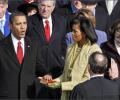
Forty-six years after the late iconic civil rights leader Rev. Martin Luther King--who was inspired by Mohandas Gandhi-- delivered his 'I have a dream' speech on the steps of the Lincoln Memorial, Barack Hussain Obama, whose campaign theme was 'Yes, we can," was sworn in at 11.56 am on January 20th as the nation's 44 president and the first ever African American chief executive on the steps of the west front of the Capitool in the presence of over an unprecedented crowd.

In an exclusive interview with rediff.com, Penn said, "It was a very humbling experience to have that sort of a set-up and to see so many people who have come out for something that symbolises unifying the country."

The man who won a landmark verdict from the US supreme court now creates history once again, by becoming the highest ranking Indian American in the US department of justice.
On Monday, Barack Obama appointed Bansal as General Counsel and Senior Policy Advisor at the Office of Management and Budget, which one Obama transition team source told rediff.com would "be the heart of the new administration's agenda for change."
Some South Asian experts in Washington, DC argue that such an envoy should concentrate only on Afghanistan and Pakistan; another section holds that India should be included and that a discussion on Kashmir is inevitable; and a third section of opinion contends that the whole idea is misguided.
Soon after Barack Obama is sworn in as the 44th President of the United States, a small team of key aides will move into the White House to give a jump start to the administration's agenda. Vans will take about 20 senior officials of the incoming Obama Administration to the White House even before the inauguration ceeremony ends on Tuesday afternoon. On Wednesday, the first full working day of the new President, Obama has convened meetings on economy & foreign policy.
Strategic affairs specialist Ashley Tellis believes the November 26 terror attacks on Mumbai has given birth to the "misguided notion" that a resolution of the Kashmir dispute is imperative to rein in terrorism in South Asia, and that this should be the priority of the proposed special envoy to the region.
Sources close to Mohamed Mushin say he regrets the indiscretion of purchasing the shares that he did, and even though it was perfectly legal, it gave the perception of conflict of interest, that his buying them under the Friends and Family IPOs seemed as it was a quid pro quo by the two companies that had secured handsome Bank contracts.
The IPO offerings to Bank officials were "the least of the Bank's problems. At the end of the day, whatever they may have gotten with stock options or whatever, I think is nothing compared to the rampant corruption that is being practiced on the Bank's lending operations," says former Bank official Steve Berkman.
This would make him the highest-ranking Indian American ever in the US Department of State. Over a month ago, Verma was appointed as one of the leads of the Agency Review Team overseeing the US Department of Defence for President-elect Barack Obama's Transition.
Indian Intelligence agencies have drawn much flak for their glaring lack in communication that failed to preempt the 26/11 terror attacks last year. American intelligence agencies operating in South Asia also don't share information with each other, Massachusetts Democrat and Senator John F Kerry, who recently visited Indian, Pakistan and Afghanistan, revealed during a Congressional hearing on Tuesday.
United States President-elect Barack Obama's Secretary of State designate Senator Hillary Clinton, appearing before the Senate Foreign Relations Committee as part of her confirmation process on Tuesday, said that the Obama administration will condition military aid to Pakistan, on its commitment to counter-insurgency and counter-terrorism.
The incoming Obama administration on Tuesday declared that the Mumbai terror attacks threw up new challenges for American diplomacy. US Secretary of State designate Hillary Clinton listed the 26/11 strikes as among the six major new challenges for American leadership though diplomacy that has emerged since the November presidential elections.

United States Secretary of State designate Hillary Clinton on Tuesday vowed to build on the economic and political partnership with India, as she said that US and the world leaders must work together to solve the most pressing problems. "We will build on the economic and political partnership with India, the world's populous democracy...," she told a Senate confirmation hearing.
Congressman John Conyers of Michigan -- Gupta's home state where he was born and raised and went to medical school -- in his letter urged his fellow Democrats to join him in 'signing a letter to President-elect Barack Obama that Dr Sanjay Gupta not be nominated for the post', arguing that the celebrity physician and medical correspondent 'lacks the requisite experience needed to oversee the federal agency that provides crucial health care assistance.'
United States vice president-elect Joe Biden will lead a bipartisan Congressional delegation on a visit to Southwest Asia before he takes office alongside Barack Obama on January 20. For security reasons, details of the trip and the countries to be visited have not been released. Biden would be accompanied by Senator John Kerry, the former Democratic Presidential candidate and the incoming Chairman of the powerful Senate Foreign Relations Committee.
Two weeks ahead of his inauguration, United States President-elect Barack Obama's incoming cabinet faced a hiccup when Commerce Secretary-designate Bill Richardson withdrew citing an ongoing federal grand jury investigation
Former chairman of India's Atomic Energy Commission Dr M R Srinivasan said India's nuclear reactors, spread along the country's coastline, are secure against the threat of terrorist strikes.
Retired Vice Admiral P S Das said the methodology of 26/11 clearly indicated that the terrorists had received months of professional training, most likely from Pakistan's Inter Services Intelligence.
At a seminar in Washington, DC, a group of former diplomats, military leaders, politicians, businessmen and others said the minimum requirement from Pakistan is 'an irrevocable disbandment of the infrastructure of terrorism.'
